Showing posts with label global warming. Show all posts

Wednesday, May 22, 2013

Is Global Warming breaking up the Integrity of the Permafrost?

Permafrost was long thought to act as a cap preventing methane from hydrates to enter the atmosphere. For many years, University of Alaska Fairbanks scientists Natalia Shakhova and Igor Semiletov studied methane emissions in the Arctic Ocean. In a 2010 press release, Shakhova said: "The amount of methane currently coming out of the East Siberian Arctic Shelf is comparable to the amount coming out of the entire world's oceans. Subsea permafrost is losing its ability to be an impermeable cap."

Is something similar happening to the permafrost in Antarctica and on the Himilayan Plateau? As the image below shows (mid-May 2013 levels, image added later by Sam Carana), very high levels of methane can be present over Antarctica around this time of year.


The chart below shows very high methane levels over Antarctica in April and May 2013. High levels of methane over Antarctica were recorded before in 2013, as described in an earlier post at the methane-hydrates blog.


While above chart gives the peak readings at an altitude of 19,820 ft (or 6,041 m), the highest methane readings over Antarctica were not always recorded at that altitude. On April 29 and 30, 2013, when the above chart shows relatively low peak readings, readings of 2225 ppb were recorded at a lower altitude (14,385 ft or 4,384 m) over Antarctica. Similarly, the image below shows a reading of 2247 ppb on April 4, 2013, at that same lower altitude, higher than the peak reading for that day on above chart.


Are these high methane levels indications that global warming is breaking up the integrity of the permafrost in Antarctica as well?

The Himalayan Plateau, also known as the Qinghai-Tibetan Plateau, or the world’s “third pole”, is located in central Asia and also contains huge quantities of permafrost. Methane hydrates were discovered on the Qinghai-Tibet Plateau in September 2009 in quantities estimated "to equal at least 35 billion tonnes of oil", according to a 2010 Xinhuanet report.

The above chart with Antarctic daily peak methane readings gives an estimate for the highest methane reading over Antarctica on April 26, 2013. This because Antarctica didn’t appear to have the highest reading on that day, when methane readings were recorded of 2405 ppb at 469 mb pressure and of 2475 ppb at 367 mb pressure. The methane that caused these readings appears to originate from the Himalayan Plateau, as illustrated by the image below.


What could have caused such extremely high methane emissions?

Could the methane have been released from wetlands? It was very hot around that time in South Asia, as illustrated by the image below showing temperatures in degrees Celsius for April 28, 2013. But the emissions appear to originate from an area with little vegetation, which also appears to rule out burning of biomass waste from rice productions as a cause.


Another explanation for such high methane readings is that they were caused by earthquakes. The image below shows a string of earthquakes that hit China, including a magnitude 6.6 quake on April 20, 2013, and a magnitude 5.3 quake on April 24, 2013.


It could be that the earthquakes lead to large methane releases from ruptured natural gas pipes and tanks. On the other hand, the methane releases appear to occur over a large area well next to the epicenter of the earthquakes, as shown on the animation below.


Also, methane releases associated with such a natural disaster would have been a one-off event. High methane levels did occur before over the Himalayan Plateau, as illustrated by the image below showing readings for several days in 2013 at the same altitude, including a reading of 2235 ppb on February 1, 2013.


Such recurring high readings could indicate that methane is bubbling up through the permafrost at the Himalayan Plateau. Shockwaves caused by the earthquakes could have accelerated the movement of free gas through the top layers of permafrost and they could also have caused destabilization of one or more methane hydrates, resulting in large abrupt release of methane into the atmosphere on April 26.

Loss of the integrity of the permafrost is particularly threatening in the Arctic, where the sea ice looks set to disappear within years, resulting in huge albedo changes in summer. Decrease of surface reflectivity results in increases in absorption of energy from sunlight and decreases in shortwave radiation in the atmosphere. The latter results in lower photo-dissociation rates of tropospheric gases. Photo-dissociation of the ozone molecule is the major process that leads to the production of OH (hydroxyl radical), the main oxidizing (i.e., cleansing) gas species in the troposphere. A 2009 NASA study projects this to lead to a decrease in OH concentrations and a weakening of the oxidizing capacity of the Arctic troposphere, further increasing the vulnerability of the Arctic to warming in case of additional methane releases.

Levels of greenhouse gases such as carbon dioxide and methane are already very high in the Arctic atmosphere, while large quantities of black carbon get deposited on snow and ice, further contributing to the albedo changes. This threatens to result in rapid summer warming of many parts of the Arctic Ocean with very shallow waters. Additionally, rivers can bring increasingly warm water into those shallow seas in summer, adding to the threat that heat will penetrate the seabed that contains huge quantities of methane.

Methane at up to 2241 ppb on January 23, 2013 - this is a 2.42 MB animation that may take some time to fully load

Above image, earlier included in a post at the Arctic-news blog, shows methane concentrations on January 23, 2013, when a reading of 2241 ppb was recorded in the Arctic. 

Analysis of sediment cores collected in 2009 from under ice-covered Lake El'gygytgyn in the northeast Russian Arctic suggest that, last time the level of carbon dioxide in the atmosphere was about as high as it is today (roughly 3.5 to 2 million years ago), regional precipitation was three times higher and summer temperatures were about 15 to 16 degrees Celsius (59 to 61 degrees Fahrenheit), or about 8 degrees Celsius (14.4 degrees Fahrenheit) warmer than today.

As temperatures rose back in history, it is likely that a lot of methane will have vented from hydrates in the Arctic, yet without causing runaway warming. Why not? The rise in temperature then is likely to have taken place slowly over many years. While on occasion this may have caused large abrupt releases of methane, the additional methane from such releases could each time be broken down within decades, also because global methane levels in the atmosphere were much lower than today.

In conclusion, the situation today is much more threatening, particularly in the East Siberian Arctic Shelf (ESAS), as further described in the earlier post methane hydrates.

Saturday, March 3, 2012

Large areas of open ocean starved of oxygen

“The water is getting warmer, and warm water holds substantially less oxygen than cold water . . . Off southern California over the past 22 years we’ve lost about 30% of the oxygen at depths of around 200 to 300 metres,” said Professor Lisa Levin of the Scripps Institution of Oceanography in La Jolla, California.

Deep-water temperature gauges off Spitsbergen in the Arctic and in the Southern Ocean near the Antarctic have recorded temperature increases of between 0.03°C and 0.5°C, and as much as 1°C, which is highly significant for a stable environment that does not change at all from one century to the next, she said.

“Those are significant numbers. The warming is more intense at the sea surface but it reaching the deep water,” Professor Levin said.

Above from: Report by Steve Conner in the Independent, February 21, 2012.


Why oxygen depletion is a problem

The above report is particularly relevant in regard to methane hydrates, as illustrated by the text below, which is partly from: Oxygenating the Arctic, by Sam Carana.

When methane is released from hydrates in underwater sediments, much of it can still be oxidized in the water. This would not be the case for large releases of methane, which would cause oxygen depletion, resulting in much of the methane entering the atmosphere. Furthermore, global warming makes the situation worse, as warmer water holds substantially less oxygen.

A two-part study by Berkeley Lab and Los Alamos National Laboratory shows that, as global temperature increases and oceans warm, methane releases from clathrates would over time cause depletion of oxygen, nutrients, and trace metals needed by methane-eating microbes, resulting in ever more methane escaping into the air unchanged, to further accelerate climate change.


In many ways, global warming sets the scene for catastrophic releases of methane in the Arctic. To avoid such scenarios, or even more worrying scenarios in the Arctic, it may be helpful to artificially add oxygen to the water. This has been done before, e.g. in lakes in Finland.


Oxygenating the Arctic

On the one hand, oxygenating Arctic waters seems beneficial, as this could enhance oxidation of methane in the water. Also, oxygen bubbles could form an insulating layer in between an ice-cap and warming water underneath the cap. Thirdly, bubbles could brighten the water, changing albedo and reflect more sunlight back into space. Where oxygen enters the atmosphere, this may help with the formation of hydroxyl and subsequent oxidation of atmospheric methane.

On the other hand, though, some processes could be counter-productive. As an example, bubbles could disturb a hydrate and accelerate release of methane. Rising bubbles could take more methane along upwards than they help oxidize. Experience in Finland shows that adding oxygen could also increase concentrations of nitrous oxide, a greenhouse gas with tremendous global warming potential. Also, producing oxygen locally through electrolysis could result in the release of hydrogen that could bind with oxygen or result in hydroxyl and stratospheric ozone depletion.

From: Nutrient reductions through engineering approaches, 2009
Tests are therefore recommended, in order to research what kind of impacts and side-effects can be expected. Proposals have been around for years to ventilate bottom waters by stimulating mixing with waters from mid- or upper-levels, as depicted in the above image from a study by Daniel Conley, or by adding air to the waters locally.


Transporting oxygen to the Arctic

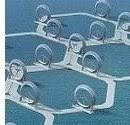
Offshore Wind Turbines on Floating Bases
Wind turbines on
floating bases
Producing large amounts of oxygen from water locally may result in large amounts of surplus hydrogen, for which there is may not be enough local demand to make this process economic. This wouldn't be such a problem when producing the oxygen at lower latitudes. Wind turbines on bases, floating offshore the coast of, say, California, New York or the U.K., could supply electricity for use on land during the day, while at night powering electrolysis of seawater (possibly preceded by distillation), to produce oxygen and hydrogen.

The hydrogen could then be used to power transportation, in particular shipping, since the oxygen would be transported by ship, either liquefied or as compressed gas, to the Arctic. On arrival, a hose could be lowered from the ship into the water to release oxygen, or - in another application - a balloon could be launched, raising a hose to the desired height, and oxygen could be pumped up the hose for release into the atmosphere, in efforts to oxidize methane in the atmosphere.

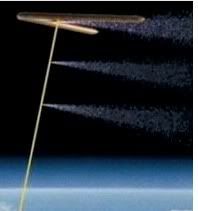
Space Hose
Space Hose
If wanted, the same hose could also be used to release aerosols into the atmosphere, in further efforts to keep the Arctic from overheating. Finally, such hoses could carry devices to monitor composition of water and atmosphere, temperatures, currents and winds at various altitudes, etc.

Funding for the project could be provided in part by the electricity sold by the offshore turbines. To further fund the project, fees could be imposed on international shipping and aviation, e.g. on departures from U.S. seaports or airports, or on bunker fuel and jet fuel taken on board such ships or airplanes. The revenues of these fees could be used partly to fund the Arctic oxygenation project, and partly to fund rebates on hydrogen that is produced at the floating bases and sold to ships anchoring there. Such feebates could also satisfy calls by the European Union for airlines to join in with action on climate change.

Alternatively, such feebates could be imposed on international shipping only. Other types of feebates could then be imposed on international aviation, e.g. to fund air capture of carbon dioxide and the production of biofuel either in algae bags or as a result of pyrolysis of organic waste. More generally, feebates are the most effective way to facilitate the shift towards a sustainable economy.


Another approach: diatoms

Another approach is suggested by Nualgi.com who propose to add iron and other trace metals/micro nutrients to the water in order to stimulate growth of a specific type of phytoplankton called diatom algae, which through photosynthesis absorb carbon dioxide in the water and add oxygen. The oxygen is then used by methanotroph bacteria to oxidize methane. 

The image below pictures a range of Arctic geoengineering methods that could be used as part of a comprehensive plan of action to deal with climate change. 


(click on image to enlarge)